Walk into most organized children's rooms and you will find storage designed by adults, for adults: shelves above head height, handsome boxes with lids, and a categorisation system so refined that only the person who invented it can maintain it. Then everyone wonders why the child does not tidy up.
Children tidy away things they can reach, see, and identify. That single sentence explains almost every failed kids' room system, and fixing it changes the dynamic entirely: build storage at child height, with visible contents and obvious homes, and a surprising amount of tidying starts happening without a grown-up standing over it. This guide covers decluttering toys without a battle, building a system a four-year-old can run, the rotation trick that cuts mess dramatically, and the daily reset that holds it together.
Start by Having Less
No storage system rescues a room with too much in it. Decluttering comes first — and the FAQ's approach is the one that avoids a fight: involve the child, go gradually, and use a holding box rather than a bin bag.
- Sort together in short sessions, asking questions rather than announcing decisions. Children who have real authority over a few untouchable favourites cooperate far better on everything else.
- Use a holding stage: uncertain items go out of sight for a few weeks. If nobody asks, they leave without drama. This one habit removes almost all the emotional heat.
- Do the obvious clearing alone: broken toys, incomplete puzzles, outgrown things. Nobody needs a negotiation about a jigsaw with three pieces missing.
- Frame it positively — making room for what they love, passing things to children who will use them — rather than as punishment or loss.
- Address the inflow too. If toys arrive faster than they leave, no amount of sorting keeps up; a quiet word with generous relatives about experiences or consumables instead of more plastic is part of the system.
Build It at Child Height
This is the design principle everything else follows from. If a child cannot reach a shelf, that shelf is adult storage — useful for spare bedding or out-of-rotation toys, useless for anything you expect them to put away themselves.
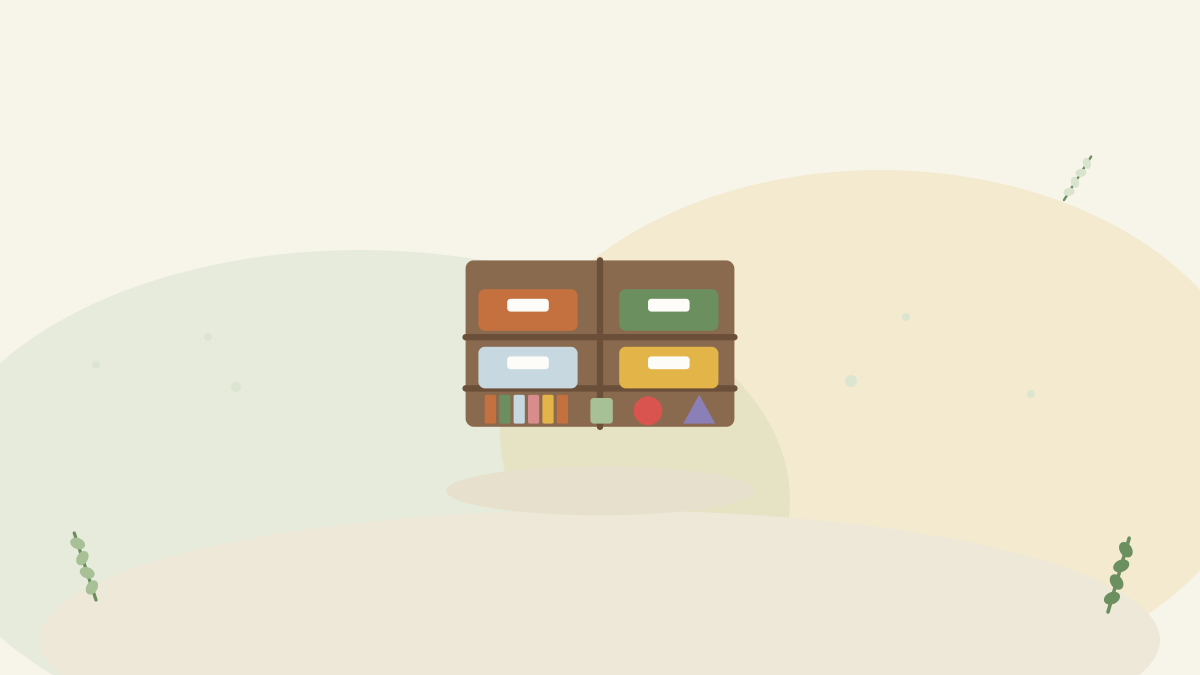
- Low, open shelving is the backbone: contents visible, nothing to lift or open, everything reachable.
- Open bins beat lidded boxes. A lid is a barrier, and for small children it is often the difference between putting something away and dropping it on the floor.
- Use the high shelves for adult things — rotation storage, keepsakes, things needing supervision.
- Hooks at child height for coats and bags do the same job the entryway guide describes: a child who can reach their own hook uses it.
- A clear floor area matters as much as the storage: children need space to actually play, and a room crammed with furniture pushes play into the corridor.
Categories a Child Understands
Adults enjoy fine-grained sorting; children do not use it. The FAQ is clear on this: broad, obvious categories beat detailed ones — one bin for vehicles, one for animals, one for building bricks, one for art materials. If sorting a toy requires a judgement call, it ends up on the floor.
Label with pictures for pre-readers — a photograph of the contents on the front of each bin removes every question about where something goes, and adding the word alongside supports reading as they grow. Colour coding works well too, especially in shared rooms where each child has their own colour.
| Category | Storage that works |
|---|---|
| Building bricks and construction | Deep open bin — dumping and scooping is how they are actually used |
| Small figures, cars, animals | Shallow bins or drawers, one type each, so things are findable |
| Puzzles and board games | Flat stacking, on a shelf, with pieces bagged inside boxes |
| Art materials | Near a surface to work on; supervised items higher up |
| Books | Front-facing display where possible — covers sell books to children far better than spines |
| Soft toys | One generous container, with an honest limit on numbers |
| Tiny fiddly sets | Lidded boxes on a higher shelf, brought down on request — the one good use of lids |
Toy Rotation: The Quiet Trick
The FAQ explains why it works; here is how to run it. Box up a good proportion of the toys and store them out of reach — a cupboard, the top of a wardrobe, under a bed. Every few weeks, or whenever interest visibly flags, swap a boxful for one that has been in circulation. Keep the genuine everyday favourites permanently available; rotation is not about removing the comfort toy.
The effects are consistent and worth the small effort: less mess (fewer things to spread out and tidy), deeper play (less choice fragmentation), and renewed interest in toys that return after a month feeling new. It also quietly reduces the pressure to buy more, which is the sustainability angle the reduce-plastic and food-waste guides would recognise: the best new toy is often one you already own, put away for a while.
The Daily Reset
The FAQ's tidying advice, made into a routine:
- Tie it to a fixed point — before dinner, before bath, before bed. A predictable slot removes the nightly negotiation.
- Do it together with younger children. "Tidy your room" is an overwhelming instruction to a four-year-old; "you do the bricks, I'll do the books" is achievable.
- Use a timer or a song to give it a clear end point. Ten minutes of tidying with a defined finish is very different from an open-ended chore.
- Aim for baseline, not perfection. The goal is a room that resets to reasonable daily, not one that stays tidy — a tidy child's room is usually a room nobody is playing in.
- Keep expectations age-appropriate: bricks in a bin at three, sorting shelves at eight. Asking for more than the age delivers produces resistance, not tidiness.
Matching the System to the Age
| Age | What works |
|---|---|
| Toddler (1–3) | Very few categories, open bins at floor level, picture labels, heavy rotation. Tidying is done together, always. |
| Preschool (3–5) | Broad categories they can sort themselves; low shelves; picture-plus-word labels; a short daily reset with a timer. |
| Early school (5–8) | More categories, some fine sorting, their own responsibility for the reset with reminders; a homework zone appears. |
| Older (8+) | Involve them in designing the system — ownership matters more than optimisation. Desk and study storage; clothes fully self-managed. |
The important principle across all of them is that the system should be slightly easier than the child's current ability, not harder. A system pitched at what a child could theoretically manage on a good day gets used on good days only; one pitched slightly below gets used consistently, which is what actually keeps a room in order.
The Rest of the House
Children's belongings do not stay in children's rooms, and pretending otherwise is why living rooms fill with plastic by evening. It is far more realistic to plan for it: keep a designated basket or box for toys in the main living space, with the understanding that it gets emptied back to the bedroom in the daily reset. This gives children permission to play where the family actually is — which is what they want and what most parents prefer — without the toys becoming permanent residents of the sofa. The same logic applies to the entryway (a hook and a basket each, per that guide), the car, and anywhere else things accumulate. A useful rule that scales with age: things can travel around the house during the day, and they travel back at the reset. What matters is not confining children's things to one room, but ensuring everything that leaves has a known way home.
Clothes, Books and the Rest of the Room
- Clothes at child height — a low rail and reachable drawers let children dress themselves and put laundry away, which is the same self-service principle as the toys.
- Limit what is out: a manageable selection of clothes in circulation, with out-of-season things stored elsewhere, exactly as the wardrobe guide recommends for adults.
- Books front-facing where you can, in a small rotating selection rather than every book they own — the same rotation logic, applied to reading.
- A homework or craft zone for older children, with its own supplies, following the desk guide's principle that the working surface stays clear for actual work.
- Under-bed storage is the most underused space in a child's room, ideal for rotation boxes and flat items on wheels.
- Shared rooms need clear personal territory: each child's own shelf, own colour, own bins — most sibling storage disputes are boundary disputes.
Where Children's Art Goes
Every family accumulates it, and nobody plans for it. A workable system has three parts: a display space (a string with pegs, a pinboard, the fridge) that holds a rotating current selection; a keep box — one box per child, with the honest constraint that when it is full, something comes out before something goes in; and photographs of the rest, which preserves everything at no physical cost. Sorting with the child, keeping the genuinely special pieces and photographing the rest, avoids both the guilt of quiet disposal and the slow burial of the house under paper.
Keeping It Going
Like every system on this site, this one needs two speeds. The daily reset handles the everyday, and takes minutes because everything has an obvious home. The seasonal edit handles accumulation: every few months, go through with the child, remove what is outgrown or broken, refresh the rotation boxes, and check that the categories still match how they actually play — because a four-year-old's system does not suit a seven-year-old. Birthdays and holidays are natural moments to do it, ideally just before the influx rather than after.
Expect the system to need adjusting as children grow, and treat that as normal rather than as failure. The measure of success is not a magazine-tidy room; it is a child who knows where things live and can put them there without help.
The Classic Mistakes
- Storage above child height, guaranteeing an adult has to run the system.
- Lidded boxes everywhere, adding a barrier to every put-away.
- Categories too fine for a child to sort without asking.
- Decluttering behind their back, breeding anxiety and hoarding.
- Everything out at once, producing both more mess and shallower play.
- Expecting a tidy room rather than a room that resets daily.
The Bottom Line
A children's room works when the child can run it. Declutter first, with them rather than behind them, using a holding box to take the heat out of decisions. Then build low: open bins, reachable shelves, broad categories, and picture labels that let a pre-reader put things away without asking. Rotate a good share of the toys out of circulation to cut mess and deepen play, and hold the whole thing together with a short daily reset done together at a fixed time. Edit it seasonally as they grow. Do that, and the room stops being a daily battleground and becomes what it should be — a space that gets thoroughly messy through play, and returns to order in ten minutes because a four-year-old knows exactly where everything lives.

Comments
No comments yet. Be the first to share your experience.